Category: blog

  • How do I say “with someone” in Finnish?

    How do I say “with someone” in Finnish?

    Miha asks:

    Hey, I’ve been trying to understand this for quite some time now, if I want to say “with my dad”, then how is genitive formed? Isänin kanssa? Mun isän kanssa? It’s the -n ending that confuses me here.

    My answer:

    Thanks for the great question! Combining possessive suffixes and genitives in Finnish is a confusing topic. As you already know, kanssa “with”, needs to be preceded by the genitive case:

    isän kanssa

    with father

    When you want add “my” to this, to say ”with my dad”, you have a few different options:

    mun isän kanssa – with my dad, spoken, informal

    mun isäni kanssa – with my dad, spoken, more formal

    isäni kanssa – standard written

    minun isäni kanssa – written, emphasizing the “my” (with MY dad, not yours)

    However, when you add a possessive suffix -ni, no further transformation is required with kanssa:

    isäni kanssa

    If you’re not using possessive suffixes, you need the genitive:

    mun isän kanssa

    This also goes for other situations where you would normally use the genitive, possessive suffixes are enough on their own:

    isäni polkupyörä= mun isän polkupyörä = my father’s bike

    Näetkö isäni? = Näetkö mun isän? = Do you see my father?

    I hope this helps!

    Text on a light pink background: How do I day "with someone" in Finnish? Illustration of two brains chatting in the background.
  • How do I say “actually” in Finnish?

    How do I say “actually” in Finnish?

    A lovely private student of mine asked me how to translate actually to Finnish. I immediately answered “oikeastaan”, but after our lesson, I got to thinking about how there’s a bit more to it.

    These are (at least) two different ways of saying “actually” in Finnish:

    1. Oikeastaan
    2. Itse asiassa

    They can usually be used interchangeably, but there are some differences in tone and even meaning.

    I couldn’t find any proper research on these (not that I looked very hard, let me know in the comments what I’ve missed), so this post is based on my own intuition and on a very quick look at some publicly available data.

    1. Oikeastaan

    can be translated to both “actually” or “really.” It works well when you’re talking about how things really are, what is really going on in the world:

    Mitä oikeastaan tarkoitat?

    = What do you actually mean?

    Oikeastaan also works really nicely when you want to make a suggestion:

    Oikeastaan mä haluaisin olla tänään kotona. Tilataanko pizzaa?

    = I would actually like to stay at home (literally: be at home) today. Shall we order some pizza?

    So what I might mean here is, if I’m completely honest with you, I’d like to stay at home.

    2. Itse asiassa

    This one is, in my opinion, the slightly better translation for “Well, actually…”, when we mean “I think I know more about this than you do.”

    Kurkut ovat itse asiassa hedelmiä.

    = Cucumbers are actually fruit.

    Itse asiassa is also a great way to suggest that you have a new idea:

    Itse asiassa, mehän voitaisiin mennä junalla!

    = Actually, we could take the train!

    / You know what? We could take the train!

    Fluent Finnish speakers, do you agree with me? And can you think of other ways of saying “actually” in Finnish?

  • My top 10 tips for YKI, version 2.0

    My top 10 tips for YKI, version 2.0

    My previous post about preparing for YKI was written over two years ago, and also at a time when I wasn’t quite up to speed on the latest developments in the world of YKI. Now, I’m regularly helping students prepare for their YKI exams again, so it’s high time for an updated version!  

    1. Start by getting on idea of what your current level in Finnish is.  If you have access to a Finnish language professional to help you figure out what your current level is, great (you could even hire me to help you with this if you like). If you don’t (and actually, even if you do), check out the criteria for the YKI skill levels. While your’re reading the criteria, think about your current skills. Where are you on the YKI scale at the moment? The YKI levels correspond with the CEFR levels, so you might want to check out those as well. Helsingin aikuisopisto also has a test to help you with self-assessment. 

    2. Set a realistic goal. If you’ve only just begun to study Finnish, it’ll take a year at the very least to get to level 3, and this is if you can study and practice daily. It might take much longer, because things like life and stress and insomnia and falling in love and spending all your time playing the guitar have a tendency of getting in the way of language learning. But if you have all the right resources to study hard and learn quickly, it’s possible to get there in a year. 

    3. Make some kind of plan. When will you take the test? Will you attend a course or hire a private teacher beforehand to help you prepare? Will you use a textbook? There are many excellent teachers and YKI courses out there, but some great options are my very own Steps towards YKI online courses. 

    4. Practice with Yle’s YKItreenitIf you plan to attend a course, you might also do these during the course, but some repetition never hurts. Gimara also has some great, free materials to help you practice for YKI. 

    5. Read Hanna Männikkölahti’s YKI tips on her excellent blog Random Finnish Lesson

    6. Sign up for the test as early as possible. Before the current pandemic, you already had to be quick to secure a spot in the YKI test, especially in the Helsinki region, but now that some tests were canceled in the spring there is a real shortage of test spots, and I’ve heard that they tend to fill up in a few minutes. If it’s a possibility for you to do the test in another city than Helsinki, that might be worth considering, as there’s usually better availability in smaller cities. 

    7. Get as much information about the test as you can. Get acquainted with the structure of the test, and if at all possible, do some kind of practice test. You can find a demo test with explanations here. Most longer YKI preparative courses will include a practice test or even several. 

    8. Study in the months and weeks before the test, but relax the day, night and morning before. Panicky last minute revision may work for some people doing some tests some of the time, but the YKI test is a test with the goal of assessing all of your knowledge of the Finnish language. The day before, if you’re not ready then it’s too late anyway, so you might as well spend your time doing something fun to take your mind off it and to balance out the hard day of testing ahead. 

    9. Put it into perspective. Tests are never perfect, and they unfortunately never capture the whole truth about anyone’s language skills. So if happen to fail or get a  worse level than you hoped for, don’t despair – maybe you had a bad day or some bad luck with the topics assigned in the test. Take some time to figure out where the problem was and make plans to try again. 

    10. Believe in yourself. You can do this, I know you can!

    Kuvan otti lil_foot_ (Pixabay).

    P.S.: My next YKI course is in October 2024, and we will be focusing on the speaking part of the text. Here’s the course page! If you’re reading this at a later time, here are all my upcoming courses.

  • How do I say ”to start” in Finnish?

    How do I say ”to start” in Finnish?

    There are three very common verbs for starting in Finnish:

    1. alkaa

    Alan kohta tehdä töitä. – I will start working soon. 
    Kurssi alkaa huomenna. – The course will start tomorrow. 

    2. aloittaa

    Aloitan kohta työt. – I will start work soon. 
    Aloitan kurssin huomenna. – I will start the course tomorrow. 

    3. ruveta

    Rupean kohta tekemään töitä. – I will start working soon. 
    Or in spoken Finnish: Mä rupeen kohta tekeen töitä.

    A question that I answer almost weekly is the difference between the first two different verbs for starting, alkaa and aloittaa. There are already at least two great explanations about this in English already, this one by Random Finnish Lesson and this one by Uusi kielemme, so I’m not going to go deeper into that here.

    Instead, I want to talk a little bit more about ruveta. Ruveta is often missing for Finnish textbooks, but it’s a very common verb in spoken Finnish. It’s also used in written Finnish, but it’s a bit rarer there, which probably explains why it tends to be missing from textbooks for beginners. 

    Ruveta goes with the MA-infinitive or third infinitive in the mihin-form, or the maan-form of the verb:

    Rupean kohta tekemään töitä. – I will start working soon. 
    Ruvetaan syömään. – Let’s start to eat. 
    Hän rupesi kirjoittamaan kirjaa vuosi sitten. – She started to write a book a year ago. 
    Rupean nyt lähtemään. – “I will start to leave now”, meaning I will start getting ready to leave.

    In spoken Finnish, this form often gets shortened, and the ea in rupean turns to ee:

    Mä rupeen nyt tekeen töitä.
    Se rupes kirjottaan kirjaa vuos sitten.
    Mä rupeen nyt lähteen.

    There’s a wonderful free online spoken language course, Puhutsä suomee, that has some good exercises if you’d like to practice these forms.

    Here’s a short video of mine if you’d like to listen to some examples with alkaa, aloittaa and ruveta.


    ​Did you know all three already? Let me know in the comments!

  • What is the best way to learn Finnish vocabulary?

    What is the best way to learn Finnish vocabulary?

    A student asks:

    One of the most difficult things about learning Finnish so far has been vocabulary. I feel like it just doesn’t stick! Even when I manage to learn something, it shows up in a completely different form. Any tips?

    My answer: 

    Thank you for the great question! In my experience, people are really different when it comes to learning vocabulary, and it takes a bit of trial and error to find out what works best for you. 

    In my opinion, the very best way to learn vocabulary in Finnish is seeing and hearing the words in context by reading and listening and using them by speaking and writing. No matter what kind of learner you are, seeing and hearing words over and over again, looking them up or asking someone for them over and over again is a must. It’s important to know that it’s normal to need to look up the same word several times before it becomes a part of your vocabulary, first your passive vocabulary and then eventually your active vocabulary. It’s easy to get frustrated when you feel like you “should” know the word already, but it can help a lot to know that this is a normal part of language learning.

    This doesn’t mean that specific techniques for learning vocabulary separately aren’t useful, they absolutely are!

    Here are a few that are worth trying:

    1. Connecting the new word with something that you already know. This can be another Finnish word, but it can also be an image, a word in another language that sounds similar or even something like a feeling that you get when you think about the word.

    2. Playing with words, melody and rhythm. Writing little poems, connecting words or sentences with melodies to make songs or repeating words, phrases or sentences in a specific rhythm works really well for a lot of people. You don’t need to be a great writer or a musician to try this technique!

    3. Flashcards, especially online ones, are really popular. However, I’ve noticed that while they work brilliantly for a lot of people, not everyone gets great results with them. If you do decide to try them out, I recommend you either make paper ones or go for an app that has some kind of system to help you learn learn. Popular, good quality flascards apps include Anki and Memrise, which both help you learn systematically with enough revision. Making your own can seem inefficient, but writing the word down by hand will help you learn the word much better than going for a ready-made deck.

    4. Sticky notes. Write the word on a sticky note and and stick it somewhere where you can see it every day. This really works, but again, it’s not for everyone.

    No matter which technique you’re using, make sure you’re learning the the different forms of the word, not just the dictionary form. When learning Finnish, it’s a good idea to learn the word in the dictionary form, but its stem or stems. The stem is the  form that you add all the different endings to. Many words just have one form, like kirja ‘book’, but quite a few have two:

    puhelin ‘phone’
    stem: puhelime-

    A select few have four:
    vesi ‘water’
    stems: vede-, vete-
    partitive: vettä

    If you’re not sure which forms to learn, check out this post where I explain this in more detail. If you’re at the very beginning of your learning journey, just learn the dictionary form or entire phrases without thinking about the forms yet, that will come later!

    What has worked for you when learning vocabulary? Let me know in the comments!

  • How do I figure out my level in Finnish?

    How do I figure out my level in Finnish?

    Question: 

    I’m interested in your intermediate YKI course, but I’m not sure if I’m at a sufficient level. How can I figure out if I’m at the right level? 

    My answer: 

    The starting level for my YKI courses is the later stages of A2, sometimes referred to as A2.2 in the Finnish system. The teaching languages of my class are Finnish and English, but at this level, you should already be able to follow a class taught completely in Finnish before you start. I will be repeating things and varying my speech tempo, and will be explaining things in English as well, but it’s good to know this going in! If you’re not at all familiar with A1, A2, B1, B2, C1, C2, here’s the official global description of the CEFR levels in English.

    Here’s some material to help you gauge your current level:

    1. Speaking. Think about what you can do in Finnish. At the start of the course, you should be able to at least

    – introduce yourself
    – talk about your past experiences
    – talk about everyday topics, like the weather, where you live etc.
    – express a simple opinion
    – handle everyday interactions, like buying a coffee, buying a bus ticket etc

    You don’t have to be able to do all this elegantly, but you have to be able to manage without resorting to English. Mistakes are normal and expected at this stage!

    Making more mistakes than you used to can even be sign that you’re approaching B1, or are already there: as you learn more and more, you start struggling with putting it all into practice at once, which might even feel like you’re going backwards

    4. Writing. Pretty much the same as 1., speaking. So short messages in different everyday situations should feel doable for you before the course, as well as writing about the past, giving advice and expressing a simple opinion. Nothing complicated, just the likes of 

    Tykkään tästä, koska…
    I like this, because…

    2. Listening comprehension:

    Try “Tehtävä 1” on this website: 

    https://yle.fi/a/20-146803

    You don’t have to understand everything or get it all right, but it should feel at least doable at the start of the course. 

    3. Reading comprehension: 

    You should be able to read this interview quite easily: 

    https://randomfinnishlesson.blogspot.com/2019/08/artistihaastattelu-meeri-sarjasto.html?m=1

    Again, you don’t have to understand all of it, but you should be able to follow the main points at least without using a dictionary or translation tool. 

    I hope this is helpful and I’d love to see you there!

  • I still want to learn Finnish, but I’m not getting anywhere

    I still want to learn Finnish, but I’m not getting anywhere

    Question:

    I’ve been studying Finnish for a couple of years now, but I seem to have hit a wall. What could I do to get over this?

    My answer:

    I feel you! With any new skill, there’s often a steep learning curve at the beginning. You easily notice your own progress, and it tends to be quite rewarding. But when you get to an early intermediate level, it can even start to feel like you’re going backwards all of a sudden. You’re actually not, you just know so much more now, and because of that it’s now much harder to put all that knowledge into practice. You find yourself making mistakes with things that you “should” know by now and you feel discouraged and like you’ll never learn.

    My advice for this situation is to think about what would make learning Finnish as enjoyable as possible for you. What has been the most fun part of learning Finnish so far, for you personally? Do more of that! Or what have you always wanted to be able to do in Finnish? Start trying to do that! Try to let go of the idea of what you should be enjoying and think about what you actually enjoy. For some people, it’s really and truly conjugating verb after verb. It might be something like watching a series on Netflix, or listening to music, or a podcast, reading a blog or participating in some kind of community.

    However, in my years of teaching Finnish I’ve noticed that there’s one thing that seems to be somehow above the rest: reading books in easy Finnish or selkokieli. A good simplified version of a book is just as enjoyable (or even more enjoyable!) and valuable as the original version, and for many of my students it’s been just the thing to get out of a slump. It often works even for those who don’t enjoy reading in general.

    So a book in easy Finnish might be just the thing. Check out Hanna Männikölahti’s wonderful blog Random Finnish Lesson for tips on what to read. A book that I’ve often recommended to start with is Toppatakin alla on sydän (thank you Hanna for the tip). Another great one is Yösyttö, especially if you have small children. But there are lots and lots of options!

    If you live in Finland, books in easy Finnish are easy to access for free at your local library, but you can also buy them online. Here is a list of free book samples in easy Finnish by Hanna. One of my favorite YouTube channels, Almost Finns, has a great video about books in easy Finnish, which is another great place to start. 

    Have you ever read a book in easy Finnish? What did you think? What books would you recommend? What has helped you stay motivated with your studies in the long term? Let me know in the comments below!

  • Help me understand Pentti Haanpää’s Finnish

    Help me understand Pentti Haanpää’s Finnish

    Hugh asks: 

    I can’t understand the following sentences from “Pesäpallo, Iisakki vähäpuheinen”by Pentti Haanpää. Please can you help?

    1. Automopiilillä ne ajaa löyhöttävät Kairanmaallakin, joskaan ei Jokiperällä, jossa ei ole tietä…
    2. Jun valtion lähettämä mies, velho, lopulta nosti repun hartioilleen ja menu menojaan, niin vasta silloin jokiperäläisillä oli aikaa tehdä hammsia heinääkin.
    3. Valtio sai talvella ostaa jokiperäläisille rehuja monen monituisen miljoonan edestä, ettei karjoille olisi käynyt aivan kolosti ja lehmänanti lakannut tiukkumasta.
    4. Sillä hyvällä varalla yhtä vahingolliset ja päähänmenevät seuraukset siitä on…

    My answer: 

    What a challenging bit of reading you’ve chosen! I don’t understand all of it myself, but I’ll give it a try! Advanced vocabulary ahead.

    1. Automopiilillä ne ajaa löyhöttävät Kairanmaallakin, joskaan ei Jokiperällä, jossa ei ole tietä…

    Automopiili is an old word for car, and ajaa löyhöttävät is an expression that basically just means the same as ‘ajaa’, to drive. Kairamaa is a place name, and joskaan ei can be translated as ‘albeit’. 

    So in simpler Finnish, this could be: 

    Autolla ne ajavat Kairanmaallakin. He eivät kuitenkaan aja Jokiperällä, jossa ei ole tietä…

    I won’t even attempt an English translation that captures the tone of all the expressions well, here’s a simple version: 

    They also drive a car in Kairamaa, albeit not in Jokiperä, as there’s no road there. 

    2. Jun valtion lähettämä mies, velho, lopulta nosti repun hartioilleen ja menu menojaan, niin vasta silloin jokiperäläisillä oli aikaa tehdä hammsia heinääkin.

    I don’t know what Jun means, is it a place name? Or should it be something like kun? 

    Jun valtion lähettämä mies
    The man sent by the state of Ju?
    Kun valtion lähettämä mies
    When the man sent by the state…

    velho
    this is everyone’s favorite Duolingo word, it means ‘wizard’

    lopulta nosti repun hartioilleen
    finally lifted the backpack on his shoulders

    ja menu menojaan
    There’s a typo here, it should probably be 
    ja meni menojaan

    mennä menojaan
    is an expression that basically means the same as mennä, to go. I’d translate meni menojaan as ‘was on his way’

    niin vasta silloin…
    it was only then that…

    jokiperäläisillä oli aikaa tehdä hammsia heinääkin
    I don’t know what hammsia means, I don’t recall ever seeing such a word, and can’t find it anywhere either. Perhaps it’s from a dialect or made up by Haanpää? 

    jokiperäläiset  means more or less “the people from the end of the river”, X:llä on aikaa  means X has the time to do something, so the whole sentence would be

    ​tehdä heinää
    to make hay, so to harvest the hay that has grown in the field during the summer

    The people from the end of the river had time to also make hay

    hammsia looks like it might be an adjective in the partitive case, so it’s a word that’s describing the hay. 

    3. Valtio sai talvella ostaa jokiperäläisille rehuja monen monituisen miljoonan edestä, ettei karjoille olisi käynyt aivan kolosti ja lehmänanti lakannut tiukkumasta.

    monen monituisen miljoonan edestä = monella miljoonalla (markalla/eurolla/dollarilla)
    monen monituisen is an expression that means ‘a lot of, several’

    Valtio sai talvella ostaa jokiperäläisille rehuja monen monituisen miljoonan edestä
    The state had to spend several millions to buy feed for the river enders

    ettei karjoille olisi käynyt aivan kolosti 
    so that things wouldn’t go too badly for the livestock
    käydä kolosti  is an interesting expression that you don’t hear very often. It means the same as käydä huonosti, ‘to go badly’

     ja lehmänanti lakannut tiukkumasta.
    lehmänanti 
    lehmä + anti, from the verb antaa 
    ‘milk’

    and so the milk would keep coming

    So the whole sentence means: 

    Valtio sai talvella ostaa jokiperäläisille rehuja monen monituisen miljoonan edestä, ettei karjoille olisi käynyt aivan kolosti ja lehmänanti lakannut tiukkumasta.
    The state had to spend several millions to buy feed for the river enders so that things wouldn’t go too badly for the livestock and so the milk would keep coming.

    4. Sillä hyvällä varalla yhtä vahingolliset ja päähänmenevät seuraukset siitä on…

    This one is difficult to decipher without more context. Something has harm(vahingolliset) and intoxicating consequences (päähänmenevät seuraukset), and

    hyvällä varalla  
    is an expression that means that there’s lots to spare. 

    “Ostin hyvällä varalla ruokaa”
    I bought lots of extra food. 

    Sillä 
    could be translated as therefore here. 

    Sillä hyvällä varalla yhtä vahingolliset ja päähänmenevät seuraukset siitä on…
    Therefore, with lots to spare, the consequences are just as harmful and intoxicating. 

    Maybe this one makes sense when you read a longer passage? 

    Hope this was as helpful as it was fun to write! 

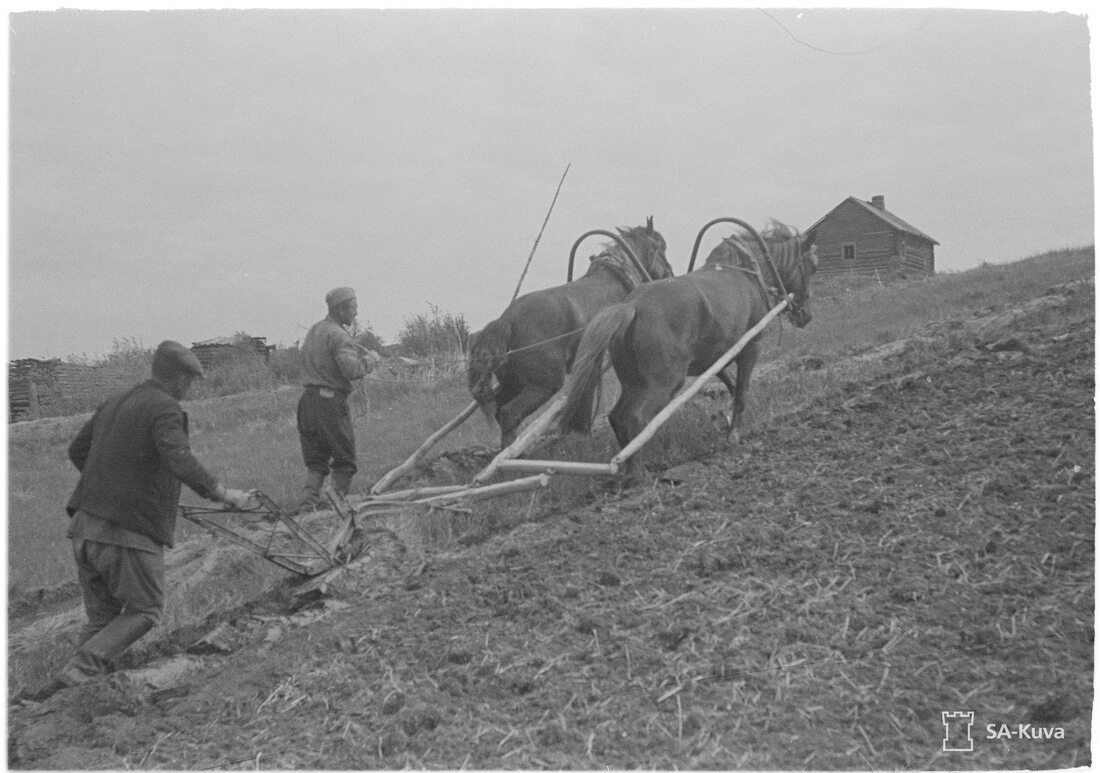
    Field work
    Peltotöitä, working in a field. Picture courtesy of Museovirasto.
  • Why aren’t there kpt-changes in the verb maksaa?

    Why aren’t there kpt-changes in the verb maksaa?

    Katja asks: 

    Why kpt vaihtelu does not take place in the word maksaa? Why k doesn’t disappear but in nukkua it does?

    My answer:

    KPT vaihtelu, KPT-changes or consonant gradation are systematic changes that happen in the different stems of Finnish words. If you’re new to these or just want to brush up on what you know, start by reading this lovely post on the brilliant website Uusi kielemme.

    For a lot of people, the best answer to your question is “because that’s just the way it is”. Many of my students find that it’s the best to just learn the different stems of any word you learn by heart. Luckily, that will also happen naturally and on its own after a while, because you will see and hear them all the time when you’re reading and listening to Finnish. It will just start sounding better to you to say minä maksan and minä nukun.

    The rules are really nice to know about though, as it helps you remember the patterns and makes it all feel less random.

    But some people learn best by learning the rules and appliying them. The important thing is to know what works best for you! So, here goes for those who love grammar rules:

    KPT-changes only happen at the last syllable of the stem, so

    nukkua – to sleep
    strong stem: nukku-
    2 syllables: nuk-ku

    The last syllable -ku has a k in it, so a kpt-change happens (kk: k), and the weak stem is

    nuku-
    minä nukun, he nukkuvat

    lukea – to read
    strong stem: luke-
    2 syllables: lu-ke
    the last syllable ke again has a k in it, so a kpt-change happens (k goes away), and the weak stem is

    lue-
    minä luen, he lukevat

    maksaa
    stem: maksa-
    2 syllables: mak-sa

    There’s no k, p or t in the last syllable, so no kpt changes can happen and the stem stays the same all along

    minä maksan
    he maksavat

    However, there are some exceptions, as always (kiitos suomen kieli!):

    1. When you start with a stem that is weak, it’s not always possible to see that there’s a k in the strong form, you just have to know, like with other verbtypes than verbtype 1:

    pelätä
    strong stem: pelkää
    minä pelkään
    he pelkäävät

    2. Also, sk, st, tk and two vowels don’t participate in kpt-changes, so
    ostaa
    stem: osta-
    minä ostan
    he ostavat

    And a handful of other stuff to mix it up, which I won’t go into here! If you want to know more, go to Uusi kielemme and read this post about consonant gradation puzzles

    What is your experience in learning and appliying kpt-changes? Are you a person who learns best through learning the rules by appliying them, or do you learn best by learning each word individually? Or maybe something in between? 

    Picture
    Breathe in, breathe out and read about kpt-changes in Finnish verbs!

  • What does the verb “koskea” mean?

    What does the verb “koskea” mean?

    Shweta asks: 

    Voisitko selittää verbi koskea englanniksi? Miten mä käytän?

    My translation: 

    Could you explain the verb koskea in English? How do I use it? 

    Moi Shweta!

    The verb koskea is quite a tricky one, as it has quite a lot of uses and meanings that all look quite different at a glance. According to Kielitoimiston sanakirja, koskea has five main meanings: 

    1. to touch, as in to touch something with your hand:

    Lapseni koski puhelimeeni likaisilla käsillään, ja nyt puhelinkin on ihan likainen!
    My child touched my phone with dirty hands, and now the phone is dirty too! 

    2. to get involved in something

    En halua koskeakaan tähän asiaan! 
    “I don’t even want to get involved with this”, so literally: I don’t even want to touch this (topic/meeting/business..)

    3. affect in a negative way

    Työttömyys koskee monia ihmisiä. 
    Unemployment affects many people.

    Tämä asia ei koske minua mitenkään. 
    This doens’t affect me in any way.

    4. to cause pain (literally or metaphorically): 

    Vastaan koskee. = Vatsa on kipeä = Vatsaan sattuu.
    (My) stomach hurts. 

    Minuun koskee, kun luen Afganistanin kriisistä. 
    Reading about the crisis in Afganistan hurts (me).

    5. to concern: 

    Nämä ohjeet eivät koske sinua.
    These instructions don’t concern you (or don’t affect you). 

    Tämä ohje koskee koko toimistoa. 
    This instruction concerns (= is applied to) the whole office.

    So the same verb can be translated to English in many, many different ways depending on the context it is used in.