I’ve answered a couple of questions about choosing the right case to use (you can find them here and here). In each of these posts, I’ve been talking about the concept of ainesana, but I haven’t really devoted time to explaining what they are and how to recognize them. So here goes!
The word ainesana is composed of two words, aine ‘material, element’ and sana ‘word’. Ainesana literally means an “element word” or “material word”, and its English counterpart is the uncountable noun. However, unlike in English, in Finnish it’s often less useful to think of these words in terms of counting. In my experience, it’s often more useful to think about dividing, and some Finnish grammars use the term jaollinen, ‘divisible’ to mean the same thing – if you can divide it, it’s an ainesana. Ainesanas behave a bit differently than other words, especially when it comes to using the partitive case.
The following groups of nouns are ainesanas:
1) food and drink: kahvi ‘coffee’, juusto ‘cheese’, mehu ‘juice’, leipä ‘bread’ 2) elements and materials: vesi ‘water’, nahka ‘leather’, tuli ‘fire’ 3) abstract concepts and feelings: rakkaus ‘love’, ystävyys ‘friendship’, ilo ‘joy’
Ainesanas are things that you can stick into a blender and mush up without them losing their essence. A mashed potato is still a potato, but stick your cellphone (not an ainesana) into your vitamix and what you get is a pile of broken plastic, glass and metal. Love remains love even when your heart is broken.
Another way to phrase the same idea is that with ainesanas, even the tiniest bit of the thing is still the thing. If you pour some coffee into a coffee cup, you now have coffee in a cup as well as in a coffee pot. Cut up a cake, kakku, and dish it out and you have lots of plates with cake. If you cut up a t-shirt in a similar way you end up with garbage, not a t-shirt, but the shards are still fabric, kangas, which of course is, again, an ainesana.
If you can divide it without it losing its essence, it’s an ainesana. If you can’t, it’s not.
Every April, I’m amazed at how Finnish is spring is pretty much identical with Belgian winter. I grew up in Belgium, where usually April means green grass, leaves and flowers. In Helsinki, April means +7 degrees and everything being grey and brown. At the moment, it’s raining. But we had some beautiful days last week, and Vappu is just around the corner! Can’t wait! On to the question of the day:
Omar writes: Mitä tarkoittaa “nimenomaan” ?! What does “nimenomaan “mean?!
Dear Omar,
Great question! Nimenomaan is one of those words that emphasizes and defines meaning, and as such it’s pretty hard to translate accurately. Nimeomaan can be translated as exactly, absolutely, totally, precisely, in particular.
You can use it to say that someone understands exactly what you mean. In this example that I just made up, Maija and Aarne are having coffee.
Maija: Tää on ihana kahvila. Aarne: Joo, mistään ei saa näin hyviä korvapuusteja! Maija: Nimenomaan!
Maija: I love this café (literally: this café is wonderful). Aarne: Yeah, you can’t get korvapuustis this good anywhere! Maija: Exactly!
You can also use it to single something out:
Maija: Tää on ihana kahvila. Aarne: Joo, nimenomaan korvapuustit on täällä tosi hyviä!
Maija: I love this café. Aarne: Yeah, the korvapuustis in particular are really good here!
To emphasize:
Maija: Mihin me mentäis kahville? Aarne: En mä tiiä, oisko Cafe Laine mitään? Maija: Mun tekis nimenomaan mieli korvapuustia. Aarne: No mut hei sit mä tiedän hyvän paikan!
Maija: Where do you want to have coffee? Aarne: I don’t know, how about Café Laine? Maija: I’m really craving a korvapuusti. Aarne: Well in that case I know just the place!
In most cases, in particular works pretty nicely as a translation for nimenomaan, so if I had to choose one word to translate it with, that would be my favorite.
Hi, I am planning to seat for YKI test. It’s been a year since I am planning this. But I have a small baby and it’s really hard to study or prepare for the exam. Can I have any suggestion on how to pass YKI test level 3. I have finished Suomen mestari 1.
Dear Sadaf,
Thank you for the great question! Studying with a small baby is definitely a huge challenge. When I think back to the first year of my own child’s life, my first thought is that it was often a huge challenge to just somehow keep everyone fed, warm and relatively clean, and to keep our home from descending into complete chaos. I don’t think it would have been possible for me personally to study for a standardized test at that time. However, that’s not to say that you shouldn’t attempt it! Babies, families and experiences are really different, and what would have been an impossible task for me may be a really fun and rewarding journey for you.
Everything I say in this post is comes with a caveat: depending on you situation, this may be really bad advice. But I hope that some of it can be helpful!
1. Is there a Finnish course for parents of small children available near you?
Depending on where you’re located, there might be a Finnish course or language café available that is specifically designed for your situation, with child care options and extra support. Your local neuvola (Finnish maternity and child care clinic, literally “the advice place”) should be able to point you in the right direction.
2. Think about how you could build some Finnish into your everyday life.
When is the best time of the day for you to learn? Learning doesn’t have to mean quiet, uninterrupted time. It can be something connected to your everyday routines: for example, you could talk to your baby in Finnish for 5 minutes every morning or have a podcast for Finnish learners on in the background of other things. Little daily routines like this go a very long way.
3. Connect with others
I know for a fact that you’re not the only one struggling with this, and many struggles become smaller when you have community. So, my advice would be to find others who are in the same situation as you are and to support each other in your efforts. I know it’s easier said than done, especially in the blur that life with a baby tends to be, but it’s well worth the effort if it’s possible for you. One option is a non-profit organization called Mothers In Business. It’s one great way to connect with others in the same situation for peer support. There are Facebook groups, online and face to face mingles and all kinds of grear events. Here’s the international wing.
Mothers in Business International has also organized language cafés and conversation groups for Finnish learners in the past (I’m proud to say that I was part of the very first chapter in 2020), and I think there might be more coming in the future.
There are many other great non-profits and organizations that can help you connect with other parents of small children. One really prominent one that is active all over Finland is Mannerheimin lastensuojeluliitto, MLL for short. Again, your local neuvola is a great place to find out what is available in your area.
4. Give yourself enough time
You still have some way to go before YKI level, and you’re in a challenging stage in your life. You’re most likely at level A1 now, which means you need to climb two more levels on the CEFR scale until you reach B1 and YKI level. From basic level, you need to get to independent level, which means that you can manage in most everyday situations if Finnish. Your goal is absolutely, 100 % reachable, but be patient with yourself and your process.
4. What textbooks to use
If you’re able to keep studying with a text book or even attend a course, it would be good to study at least Suomen mestari 2 in addition to Suomen mestari 1, preferably also Suomen mestari 3.
Or, if Suomen mestari isn’t doing it for you, you might want to opt for another texbook like Sun suomi (from 0 to A2, explanations in English), Oma suomi 1 and 2 or No niin 1 and 2. It might be worth getting these out of the library to try them out and see what resonates.
The current chapter of the course in ongoing right now. It’s still possible to join in, but it’s still too soon for your current language level. However, there will be further chapters coming up if you’re interested. The next one will be in January 2024. Here are all my upcoming Finnish courses.
Hi! I am a PhD student at Helsinki University. I am originally from Barcelona. I am currently learning finnish at the classes offered at the university, but I would like to find some lessons that are more direct to speaking and getting vocabulary, rather than learning grammar (as the ones I am currenly in). Could you recomend me any? Kiitos paljon!
Hi Aina!
There are a bunch of excellent courses that you could attend, but I don’t currently have a specific one in mind. For the Helsinki region, the options should all be listed on finnishcourses.fi. In practice, not everything is always there, so it’s also worth asking around. For instance, I’ve never listed one of my own private courses, as my one woman business is such a small player in the field and I haven’t yet had the need to advertise much.
Look for a course that has speaking (puhuminen) right in the name of the course. However, most courses will have a lot of speaking and vocabulary involved even if they don’t specifically focus on it, so it might be a good idea to contact the organizer and ask them about it directly. It sounds like your current course might be a bit of an outlier, so you might also want to check out what else is available at the uni. Maybe ask your current teacher for recommendations if you haven’t done that yet.
There are also several free clubs that you can attend to practice speaking and vocabulary, usually lead by teacher students or even professional teachers. For example, my part-time employer Helsingin työväenopisto hosts one on Mondays from 10.00-11.30 in Kallio, Helsinginkatu 26. In my time at the uni in Helsinki, we had several Finnish clubs going on, so that’s another good place to start looking.
Finally, there’s of course the option of private lessons, which are an excellent way of focusing on exactly the aspects of language that you need. I’m one good option for focusing on speaking (even if I say so myself), but there are many excellent Finnish teachers in Helsinki who offer private lessons. I also organize Finnish courses for groups. Let me know if you’re interested and we can talk more!
Readers, anything I missed? Do you have a specific course recommendation for Aina? Tell us in the comments!
This is the second part of my answer to Meri’s letter. Part one is here. Here’s Meri’s letter again:
Hi Mari,
I have some questions regarding the verb ostaa and the behavior of some nouns and the endings they take. Ostaako Peter bussilipun? Minä ostan maitoa/ jäätelöä. Assuming that the sentences are correct, which I think they are, why is it that with the same verb variations to the noun are possible? What is the difference? When do we know which variation to use? Here are my suggestions/ problems. I know that the partitive case is used for nouns that cannot be counted Maito is one such noun. You cannot count the milk, but the containers in which it is stored. However, as I see it, jäätelö can be counted, or am I wrong? One more thing. How do say that I want for example to buy tickets to a concert, for one, then the tickets to a particular concert? Would these be correct? Minä haluan ostaa lipput. Minä haluan ostaa lippuja. Thanks,
Hi Meri!
Why is it that with the same verb variations to the noun are possible? This is a question that one could write a doctoral thesis on, and actually, many have. I’ll try my very best not to.
You already gave the short answer yourself: with a verb like ostaa ‘to buy’, we need to look at the thing that we’re buying. If it’s countable, we use the genetive, just like in your example: Ostaako Peter bussilipun. If it’s not countable, or in Finnish, an ainesana, then you use the partitive.
Ainesanas are things that you can’t count: food, drink, elements and abstract things, like
vesi, tuli, rakkaus ‘water, fire and love’.
Just like you said in your letter, ainesanas can be conceptualized as countables: instead of milk, which is an ainesana or uncountable, we can talk about cartons of milk and transform our milk into countable form:
Ostan maitoa. ‘I’m buying milk’ Ostan maidon. ‘I’m buying a carton of milk.’
The same goes for jäätelö, and any ainesana for that matter. From you’re letter, I’m guessing that you’re thinking about individual ice creams. Think of big batches of gelato instead, or tubs of Ben & Jerry’s.
On a more general level, how do you choose the case?
When you’re first starting to study Finnish, the way we use our 15 cases may seem completely random and very confusing, but there’s actually a method behind what may at times seem like madness. It has everything to do with the action you’re describing, or, the verb you’re using.
Some verbs go strictly with one case, like tykätä ‘to like’. Tykätä always goes with the elative case (Mistä?):
Minä tykkään sinusta. Minä tykkää-n sinu-sta.
First there’s the word minä ‘I’, in its nominative or basic form, then the verb tykätä ‘to like’in the form that goes with minä, the first person singular: tykkään ‘I like’. Then sinä ‘you’ in the elative form, sinusta. So literally: I like “from you”, or my liking of you comes from the way you are. I like you.
Other verbs are more flexible, like the verb ostaa that we started off with. Ostaa is a transitive verb, a verb that typically takes an object: you always buy something, and what case you should use depends on the thing you’re buying: ainesana or not? If you’re not buying anything in particular, there’s a whole different verb for that: shoppailla.
So, you might saying, it’s another f***** learn it by heart situation isn’t it???
Well, you’re right, it is. On the other hand, it’s also not – when you progress further, you’ll start to grasp the underlying logic, and you’ll start to see that verbs with similar meanings behave in the same way. For example, this thing about liking from may seem totally random at first, but when you learn more verbs you start seeing a pattern:
tykkään suklaasta ‘I like chocolate.’ pidän suklaasta ‘I like chocolate.’ (pidän and tykkään are synonyms) nautin suklaasta ‘I enjoy chocolate.’ uneksin suklaasta ‘I dream of chocolate.’
In my opinion, the trick in the beginning is learning slightly longer chunks of language. Instead of memorizing tykätä + elatiivi, use it in a a longer sentence or phrase and then memorize that. If you love chocolate like I do, it could be tykkään suklaasta.
Once you know how to say you like chocolate, you also know how to say you like other things:
tykkään suklaasta tykkään kahvista tykkään kesästä tykkään Helsingistä (Helsinki : Helsingistä) … and so on.
One question that I get asked over and over is some form of this:
How do I become fluent in Finnish? Is it even possible?
I of course always answer, yes, it is! Every student that I have ever known who has put in the work and kept going has gotten there. But don’t just take it from me. Lidiia Salo, Finnish learner, B2 level Finnish speaker and founder of the wonderful YKIPass community, has agreed to share her language learning journey with us in this guest post.
My Finnish Language Learning Journey and “A Step-by-Step Guide to Passing the YKI Test” e-book
Hi, dear reader. My name is Lidiia Salo. If you think that learning Finnish is impossible, keep reading. I need to warn you that it will not be easy. There might be frustration and tears along the way, but you will make it, just like I did, and just like many others have.
Before moving to Finland
I moved to Finland 6 years ago from Moscow. I was born into a bilingual family. My parents speak Russian and Chuvash. I also learned English at school quite well, as you might have guessed from reading this article. I have always loved languages and thought that learning Finnish would be easy. Spoiler alert: it was not.
Learning 1: Life is easier when you don’t have many expectations. The same applies to learning Finnish.
On my way to the Finnish language classes, Lidiia’s photo
Even before moving to Finland, I knew I would need to learn the language if I wanted to build my life there. I found an inspiring tutor online, who was a polyglot and spoke 11 languages. I thought things were working out just fine; we met once a week and practiced the basics of the language. Until one day, my husband overheard our lesson. He was confused and kindly suggested that I look for another teacher, as what my tutor was teaching me was not Finnish.
Learning 2: If you wish to hire a Finnish language tutor, choose a native speaker or a bilingual person.
I listened to my husband and found a bilingual teacher whose languages were Russian and Finnish. Eila, if you are reading this, know how great you are. At the same time, I received a letter from the TE-office stating that I had been accepted into the language course. It’s a part of the integration program in Finland. Our lessons with Eila ended, and another chapter began.
Edupoli and the best language learning grouP
The language courses provided by the TE-office are held from Monday to Friday for one year. You study the language for 5 hours a day and reserve 2 hours for homework. The course also includes aspects of Finnish working life (työelämä).
The school I enrolled in was called Edupoli back then, and it is now known as Careeria. Fortunately, I had been studying Finnish beforehand because I later discovered that I had taken the spot of a person who left the course, and missed a few lessons at the beginning.
Learning 3: If you have the opportunity to join the integration program, please don’t miss it. There might be no other chance in your life to learn the language so intensively.
The best part of Edupoli was studying in a fast group (nopea ryhmä). We were all highly educated, with many having years of work experience in various fields such as teachers, doctors, nurses, marketers, psychologists, and so on. We became friends because all of us were facing similar challenges in Finland.
We had many school trips, visiting interesting places together. It was called “retkipäivä”. Lidiia’s photo
The day would start with a song that we sang together with a teacher (Olli, you were great as well). It was embarrassing at first, but later I started loving it. My favorite song is now Leevi and the Leavings – Onnelliset. If you have time, check it out. Finnish is funny and easy to understand there.
YouTube video of the song “Onnelliset”
Learning 4: Be open to different language learning techniques; you might fall in love with them.
After half a year, I got my first tears. I had been studying Finnish so much, putting in a lot of effort, yet I still couldn’t understand what others were talking about around me in Finnish.
Galimatias and the BreakthrougH
Then we had a winter break, and something happened in my brain; resting helped, and all of a sudden, I started understanding the conversations around me. There was no way back anymore. I will make it!
Learning 5: Do not give up; you will get there, step by step!
The second school I enrolled in was Galimatias at Ruoholahti. We were incredibly fortunate with the teacher. She was young and enthusiastic, always there when we had questions or couldn’t understand something.
Galimatias School has a very nice location by the sea, Lidiia’s photo
About the YKI Test
Right after Galimatias, I enrolled in the YKI language test. My goal back then was not to apply for citizenship but rather to check if all the efforts paid off.
There, I realized it’s not so much about the language progress but rather the test system. If you train for it well enough, you might pass the test even with a lower level of Finnish.
The most shocking part of the YKI Test for me was the speaking. Everyone was in the same room, divided by a small cardboard. Honestly, it would have been better not to have them at all because it was not helpful. Everyone was talking at the same time, which was super distracting, and I surely lost many points at the beginning just trying to focus. The reading part turned out to be less challenging than I expected.
Learning 6: Use a timer to practice for the speaking part of the YKI. Don’t worry about mistakes you might make; focus on being understood.
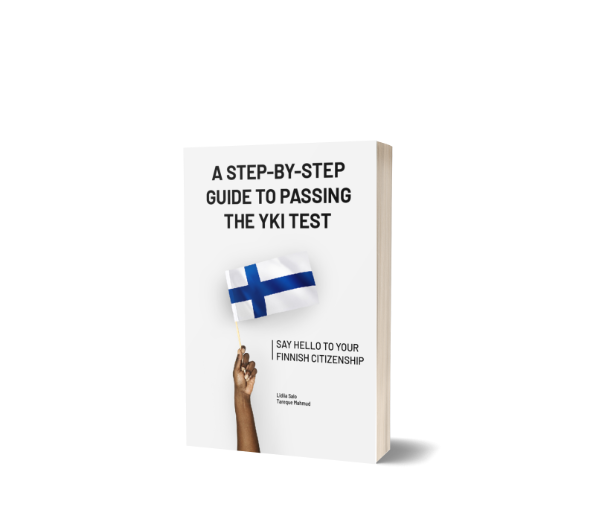
“A Step-by-Step Guide to Passing the YKI Test” e-book
I got the results of the YKI Test in 2 months and I passed all 4 parts in the first attempt. Over the years me and my friend Tareque realized that there is so much stress around the YKI Test. And there is no guide on how to pass it apart from the study and practice books. We decided if not us, then who will write it?
Cover of the e-book “A Step-by-Step Guide to Passing the YKI Test”, YKI Pass
And we have created “A Step-by-Step Guide to Passing the YKI Test”. It’s an e-book available to download for free from the website ykipass.fi. It works as a friend, being there for you on the way to passing the test. We have interviewed numerous test takers and YKI Finnish teachers to share their knowledge and expertise.
Learning 7: One piece of advice I would give to someone preparing for the YKI Test is to take a YKI-specific course when you reach level A2.
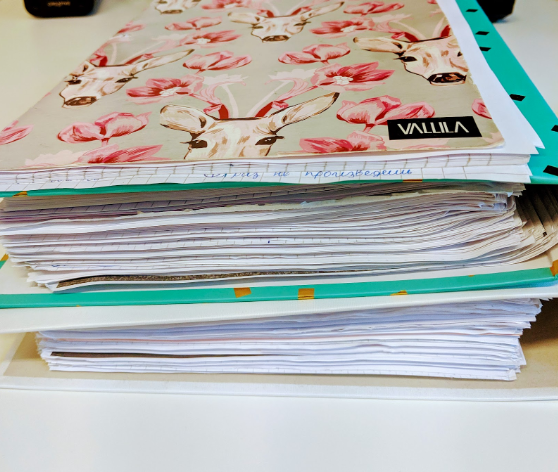
One year’s worth of study materials, Lidiia’s photo
What does the future bring?
Right now, I have reached a B2 level in Finnish. I understand almost all the conversations around me and can respond in Finnish. However, this is not the end. Language learning never ends, and living in Finland provides you with many opportunities for improvement. Trust me, it’s worth the time!
- Lidiia Salo
Mari here again!
Thank you for the wonderful and inspiring blog post Lidiia, and thank you for interviewing me including me in your recommendations in YKIPass!
I have some questions regarding the verb ostaa and the behavior of some nouns and the endings they take. Ostaako Peter bussilipun? Minä ostan maitoa/ jäätelöä. Assuming that the sentences are correct, which I think they are, why is it that with the same verb variations to the noun are possible? What is the difference? When do we know which variation to use? Here are my suggestions/ problems. I know that the partitive case is used for nouns that cannot be counted Maito is one such noun. You cannot count the milk, but the containers in which it is stored. However, as I see it, jäätelö can be counted, or am I wrong? One more thing. How do say that I want for example to buy tickets to a concert, for one, then the tickets to a particular concert? Would these be correct? Minä haluan ostaa lipput. Minä haluan ostaa lippuja. Thanks,
Hi Meri!
Thanks for the great questions! I’ll start with the second one, which is easier and faster to answer:
How do say that I want for example to buy tickets to a concert, for one, then the tickets to a particular concert? Would these be correct? Minä haluan ostaa lipput. Minä haluan ostaa lippuja.
Your suggestions are almost correct, just remember the kpt-change for the word lippu:
In a word like lippu (I call this the KATTO word type), if your have two p’s in the nominative, the word loses a p in the plural nominative (t-plural) form: Minä haluan ostaa liput ‘I want to buy the tickets’.
If you use the plural partitive, Minä haluan ostaa lippuja, it means that you want to buy some tickets. In English, I’d say I want to buy tickets.
With the plural nominative, Minä haluan ostaa liput, the sentence means that you want to buy specific tickets, and the English equivalent would be I want to buy the tickets.
My completely unresearched, subjective feeling is that in English, I want to buy tickets would usually be the way to go – in a lot of contexts, I want to buy the tickets would seem oddly specific, like you had some very specific seats in mind and no other tickets to the same concert will do. You’d use the tickets only if you’d already been discussing some specific tickets already, like this:
Anneli: I really wanna go see Maria Gasolina next week! I wonder if there are any tickets left! Heidi: OMG me too! Anneli: I’ll find out and get us tickets if there are still some left. Heidi: Awesome!
later:
Anneli: Guess what, I got the tickets!
In Finnish, however, the default in many contexts would be Minä haluan ostaa liput, and Minä haluan ostaa lippuja would be used to emphasize that the amount of tickets is nonspecific. So the same conversation would go something like this:
Anneli: Mä haluun mennä Maria Gasolinan keikalle ens viikolla! Onkohan sinne vielä lippuja jäljellä? Heidi: Et oo tosissas, niin mäkin! Anneli: Mä otan selvää ja hankin meille liput jos niitä on vielä jäljellä. Heidi: Upeeta!
myöhemmin:
Anneli: Arvaa mitä, mä sain ne liput!
As you can see, for the Finnish version I used the pronoun ne to emphasize that we’re talking about specific tickets that have been mentioned before, whereas in English the article does the trick.
Well, that was a lot of detail for a simple question! I hope I didn’t manage to just make it sound even more confusing. The bottom line is, both are correct, and which one is better depends on the specific context, which you will start to get a handle on as you progress. You’ll sound good and make yourself understood anyway. Feel free to continue the conversation in the comments if you need any more clarification on this.
For your first question, I’ll make a second post, coming up soon!
José Carlos writes: How to say in Finnish the following?
1. I CUT my finger with a knife.
2. She CUT my hair.
3. I CUT the paper with scissors.
4. I CUT the onions in slices.
5, I CUT the potatoes in cubes.
6. I CUT my hand with a broken glass.
Hi José! Thanks for the great question! The verb you want for all of these is leikata with different forms to go with it. Let’s look at them one by one.
1. I CUT my finger with a knife.
Leikata + mihin Leikkasin sormeen,
where sormi ‘finger’ is in the mihin form. So literally, I cut into my finger.
2. She CUT my hair.
Hän leikkasi minun hiukseni.
Here, hiukset is the object of the sentence. Because hiukset ‘hair’ (as in the hair on you head) almost always goes in the plural (so literally: hairs), you have two options for the form of the obejct: the t-plural – also known as plural nominative – and the plural partitive.
So without the my, the sentence would be either
Hän leikkasi hiukset or Hän leikkasi hiuksia.
Both are correct, but there’s a little difference: hiukset is what is known as the total object, so all the hair was cut and the action has been completed all the way to the end.
The partive hiuksia means that the process is still ongoing or only partially complete. I chose hiukset, as without more context it feels more intuitively correct that the haircut would be completed, but hiuksia also works just fine!
Now, we still have the my to add. In standard written Finnish, this is done with minun (my) and a possessive suffix, which goes on the singular stem of the word in the t-plural, like this:
Hän leikkasi minun hiukseni.
For a more informal and easier to form version, you can also just use the personal pronoun:
Hän leikkasi minun hiukset.
3. I CUT the paper with scissors.
Leikkasin paperia saksilla. or Leikkasin paperin saksilla.
Again, the choice between paperia (partitive object) or paperin (total object) depends on what you want to say: partitive for an ongoing process and paperin for a completed action.
4. I CUT the onions in slices.
Leikkasin sipulit viipaleiksi.
Viipaleiksi is a form called the translative, and it’s used for all kinds of transformations, like whole onions becoming slices or students graduating and becoming Finnish teachers:
Valmistuin suomen kielen opettajaksi. – I graduated as a Finnish teacher.
5. I CUT the potatoes in cubes.
Leikkasin perunat kuutioiksi.
6. I CUT my hand with a broken glass.
Leikkasin käteni rikkinäisellä lasilla.
This would be a completely literal translation of your sentence. However, in this sentence it sounds like you were holding the piece of glass in your hand and cut your hand with it (like you did in sentence number 1), presumably by accident. If the broken glass is on a table, you pick it up and accidentally cut your hand with it, the Finnish version would be something like this: Satutin käteni rikkinäiseen lasiin. So: I hurt my hand with a broken glass.
In my opinion, the key to learning any new skill is finding a good teacher, and learning Finnish is no exception. The teacher-student relationship doesn’t always have to be a formal one, but it’s important to have someone to support you in your efforts to answer your questions.
So when people ask me for advice, my first reaction is always to tell them to go find a teacher: someone teaching a Finnish course or giving private Finnish lessons, face to face or online. Every now and then, people tell me that they’ve tried this already, found it to be no use at all and decided to go on on their own. Of course, that may very well be the best option for them. People are all different, and sometimes, studying all on your own is indeed the best thing you can do for yourself and your learning process. However, for the vast majority of people, the problem isn’t that they don’t benefit from having a teacher. The problem is that they haven’t yet found the right teacher.
When I’m teaching a course (I currently teach at Helsingin työväenopisto in addition to my private lessons), I of course teach anyone who wants to attend. But when it comes to private lessons, I never take on a student if I’m not fully convinced that I have something valuable to offer them, and that I’m able to offer it. This is because I know that my success as a teacher is not just a matter of my skills as a professional, but also really depends on a variety of factors that are completely out of my control. The most important thing is just what you might call personal chemistry – people either click or they don’t, and if they don’t that doesn’t mean that there’s anything wrong with the teacher or the student.
We don’t always get to choose our teachers, and in many cases you just have to stick with the teacher that you’ve been assigned and make the best of it. In Finland, the vast majority of teachers are highly qualified and passionate about their work, so even when you don’t get to choose your teacher you have a very good chance of landing a great one. Yes, even the ones who look like they’d rather be anywhere else than in class usually turn out to be dedicated pros when you give them a chance.
If you do get to choose, I encourage you to really make an active choice. If your course or private teacher isn’t working out for you, try a different one. Ask your friends for recommendations. Also ask the teachers who it didn’t work out with – chances are they feel the same way and have a vision of what you need. Obviously, be diplomatic when doing this, but don’t be too shy either – a good professional teacher knows that sometimes they’re just not the right teacher for a given student. The bottom line is, take some time to look around and see who your options are.
That brings us to the question of the day:
How do you know that you’ve landed the right teacher?
It’s of course a plus if you like your teacher as a person, but don’t make the mistake of equating a charming personality with skill as a teacher. Yes, in the ideal situation your teacher is a fun person to work with. However, I know from my own experience as a language learner that some of my best teachers have been boring as anything. The question to ask is, are you learning from them? If the answer is no, why is that? If it’s because you get irritated at the very thought of attending yet another incomprehensible class, it’s time to move on. If it’s because you’re not putting in the work, figure out why and try your best to fix any problems that are stopping you from learning. Remember, when it comes down to it it’s you who has to take the lead of your learning process and do the work – the teacher is there to help you do it, not to spoon feed you at every step of the way. It’s your process, so take charge of it.
It’s good to know what you want from a teacher and to keep looking until you find someone whose methods work for you. Not all teaching methods work for everyone, and as education professionals trained for a minimum of five years at university level your teachers know that very well. That’s why most of us opt for lots of different types of ways of teaching in our courses, so that there’s a better chance of there being something useful there for each and every one of our students. That means that there’ll always be some part of the class that won’t be optimal for you. If you’re in my class, for example, you might be sick and tired of getting up to do yet another five minutes of moving around to Finnish punk music from the 80s, or me asking you to repeat the phrase of the day after me yet another time. If that’s the case, please be patient: we’ll usually be moving on to something else soon enough!
Whenever I get the luxury of focusing on just one student at a time (which is more and more often these days), I try to find what works for the individual student. In my opinion that’s what every pro should be aiming at doing – to find what works for their clients and then doing that. So if you have a private teacher, don’t be afraid to ask them for what you need! This of course goes for any courses as well – I love getting feedback, even when it’s negative, because that’s the best way of learning about the needs of my students and becoming better at what I do.
It’s also possible to have many teachers at once. Find ones that complement one another. I love co-teaching courses for precisely this reason.
Have you found the right Finnish teacher or teachers? How did you find them? How did you know that you had come to the right place? I’d love to hear from you in the comments!
UPDATE, 20.8.2020: See my new post here for the updated version of this post! I’m leaving this one up in case you’d like to see what resources I knew about in 2018.
Gennady asks: What are your top ten tips for the YKI-test?
YKI (from Yleinen kielitutkinto) is the language test that you have to pass at an intermediate level if you wish to apply for Finnish citizenship. The advanced YKI-test is a popular way for advanced speakers to show their proficiency to prospective employers and, for instance, when applying to universities. For the first half of my career so far, I was constantly teaching preparatory YKI-courses and also deeply involved in language testing and assessment through Testipiste, where I had the privilege of working for the first few years of its existence. However, the last time I taught a whole YKI course was in 2013, so I might not be completely up to date on the latest developments in the world of YKI. Those courses were great fun to teach, and I hope to get to teach one again in the near future.
As requested, here are my top ten tips for those planning to take the YKI test. I’ll be focusing on the intermediate one (levels 3 and 4), because it’s the one that most people take, but most of these apply to the advanced test (levels 5 and 6) as well.
1. Start by assessing your current level in Finnish. If you have access to a Finnish language professional to help you figure out what your current level is, great (you could even hire me to help you with this if you like). If you don’t (and actually, even if you do), check out the criteria for the YKI levels and maybe also the self assessment grid for the CEFR, which is available in many languages.
2. Set a realistic goal. If you’ve only just begun to study Finnish, it’ll take a year at the very least to get to level 3, and this is if you can study and practice daily. It might take much longer, because things like life and stress and insomnia and falling in love and spending all your time playing the guitar have a tendency of getting in the way of language learning. But if you’re a gifted learner and have all the right resources to study hard and learn quickly, it’s possible to get there in a year.
3. Read all of Hanna Männikkölahti’s YKI tips on her excellent blog Random Finnish Lesson.
4. Make some kind of plan. When will you take the test? Will you attend a course or hire a private teacher beforehand to help you prepare? There are many excellent teachers and YKI courses out there.
5. Check out the book Hyvin menee 2. This book is meant for students on CEFR level A2 (YKI level 2) who want to reach level B1 (YKI level 3), and if there’s a better book out there to prepare you for the YKI intermediate test I haven’t heard of it yet. Which of course is always possible, as I do have a tendency of missing things sometimes.*
6. Do all the exercises in Yle’s YKItreenit. If you plan to attend a course, you might also do these during the course, but some repetition never hurts.
7. Get as much information about the test as you can. Get acquainted with the structure of the test, and if at all possible, do some kind of practice test. Most longer YKI preparative courses will include a practice test or even several.
8. Study in the months and weeks before the test, but relax the day, night and morning before. Panicky last minute revision may work for some people doing some tests some of the time, but the YKI test is a test with the goal of assessing all of your knowledge of the Finnish language. The day before, if you’re not ready then it’s too late anyway, so you might as well spend your time doing something fun to take your mind off it and to balance out the hard day of testing ahead.
9. Put it into perspective. Tests are never perfect, and they unfortunately never capture the whole truth about anyone’s language skills. So if happen to fail or get a worse level than you hoped for, don’t despair – maybe you had a bad day or some bad luck with the topics assigned in the test. Take some time to figure out where the problem was and make plans to try again.
10. Believe in yourself. You can do this, I know you can!
* EDIT (28.10.2018): Reader Harry pointed out that Hyvin menee 2 doesn’t include answers to the excercises, which makes it a bit tricky for self study. Thank you so much Harry, I hadn’t thought of this pretty crucial aspect of self study! The answers and lots of extra material are available in a separate teacher’s guide (Opettajan opas). Also, the audio has to be obtained separately as well, and listening comprehension is a pretty important part of YKI prep, so you need to get your hands on that as well. If you’re in Finland, all of this is available for free via your local library, but if you want to buy it new, it’ll cost something in the neighborhood of 150 euros altogether.
Another, much cheaper textbook option is Suomea paremmin by Susanna Hart, which includes the answers to the exercises and the audio for about 40 euros. I don’t think that Suomea paremmin is nearly as good as Hyvin menee 2 for YKI prep (for one, the audio includes Finnish actors pretending to be learning Finnish as a second language, which… cringe!), but it has many advantages for self study. It’s much more concise so it can be a lot less overwhelming to study with, but that can be a mixed blessing – a less overwhelming textbook may mean a much more overwhelming test experience, so it’s super important that you supplement it with more demanding online materials.